Key takeaways
- Your margin is what’s left after every cost: the price you pay us, platform fees, payment processing, ad exposure, and a refund-and-remake reserve. Price from the full stack, not from that first number alone.
- Common guidance for resellers is roughly 3–4x your cost on marketplaces, and more on your own store where you carry the marketing cost yourself. Guidance, not law, but below ~2.5x the math gets thin fast.
- Personalized jewelry has no direct price comparison. A necklace with her daughter’s name on it is not a commodity. Price the moment, not the metal.
- Discounts are quietly brutal at reseller margins: a 20% sale can cost you a third of your per-order profit. Add value (gift wrap, chain upgrade) instead of cutting price.
The cost stack nobody writes down
The most common pricing mistake we see new resellers make is simple: they take what they pay us, double it, and call it a margin. Then three months later they’re staring at their payout report wondering where the money went. The money went to the stack: the five or six costs that sit between your customer’s payment and your actual profit, wherever you sell (Etsy, Shopify or your own storefront).
Here’s the full list. Every line applies to every order:
- Your cost: what you pay us for the piece, including delivery to your end customer.
- Platform transaction fees: the marketplace’s cut of the sale price (and on Etsy, of the shipping and personalization charges too).
- Payment processing: a percentage plus a flat per-order fee, on every platform, every time.
- Listing or subscription costs: small per-listing fees on marketplaces, a monthly plan on your own store.
- Advertising: both the ads you choose to run and, on Etsy, the Offsite Ads fee you don’t choose.
- A refund-and-remake reserve: personalized pieces can’t be restocked. A typo in a name, a chain-length mixup, a buyer who “expected it bigger”. Set aside 2–3% of revenue so one bad week doesn’t eat a good month.
Only after all of that is your margin. So let’s actually run the numbers on one necklace, end to end.
Worked example: one name necklace, priced honestly
Say you pick a name necklace with an all-in cost of $22: piece plus shipping to your customer. (That’s an illustrative round number for this guide, not an actual Jeweliful price; check the catalog for real figures.) You list it on Etsy at $75 with free shipping, which is about 3.4x your cost. Here’s what one order looks like, using Etsy’s published US fees as of mid-2026:
- Start with the sale: $75.00Free shipping, so the customer pays $75 flat. Every percentage fee below is taken from that full amount, including any personalization charge you add, which is why we’ll fold personalization into the base price rather than itemize it.
- Etsy transaction fee: −$4.886.5% of the order total, as of mid-2026. This applies to the item price plus shipping and personalization if you charge them separately. Another reason free shipping with everything baked in keeps the math clean.
- Payment processing: −$2.503% + $0.25 for US sellers on Etsy Payments, as of mid-2026. Unavoidable on any platform.
- Listing fee: −$0.20$0.20 per listing, renewed on each sale. Rounding error on a $75 piece, a real cost on a $19 one. Keep it in the model.
- Refund-and-remake reserve: −$2.253% of revenue set aside. Most months you keep it. The month a customer’s autocorrect turns “Naomi” into “Naomo” and you eat a remake, you’ll be glad it exists.
- Etsy Ads budget: −$3.00Illustrative: a modest daily budget averaged across orders. Yours may be zero or triple this, so plug in your own number.
- Profit: $40.17 per order, until Offsite Ads$75 − $22 − $4.88 − $2.50 − $0.20 − $2.25 − $3.00 = $40.17. A healthy 54% net margin. But if this order came through an Offsite Ad, subtract another 12–15% of the order ($9.00–$11.25) and you’re at $28.92–$31.17 on that order.
Now the cautionary version. Suppose you’d listed at $49 instead: a tempting 2.2x that undercuts everyone. Same stack: $49 − $22 cost − $5.11 in Etsy fees − $1.47 reserve − $3.00 ads = $17.42. And on an Offsite Ads order at 15%, subtract $7.35 more: $10.07. One remake wipes out two orders. That’s the difference between a business and a hobby that pays for itself in stress.
The same necklace on your own Shopify store
On a standalone store the fee stack looks friendlier, and the marketing stack looks scarier. As of mid-2026, Shopify Basic runs $39/month (less on annual billing) with card processing around 2.9% + $0.30 per online order via Shopify Payments. Same $75 necklace:
- Sale: $75.00, free shipping
- Payment processing: −$2.48 (2.9% + $0.30)
- Plan cost per order: −$1.30 (a $39/month plan spread over an illustrative 30 orders/month)
- Refund-and-remake reserve: −$2.25
- Marketing: −$12.00, the honest line. On your own store, nobody arrives unless you pay for them or earn them. $12 is an illustrative blended customer-acquisition cost; yours could be $5 with a strong social following or $25 with cold ads.
- Profit: $34.97, in the same neighborhood as Etsy, but you own the customer, the email address, and the repeat purchase.
That’s the real trade. Marketplaces charge you for traffic through fees; your own store charges you for traffic through marketing. There is no channel where the traffic is free. There are only channels where the cost is visible and channels where it hides inside percentages.
Working multipliers by channel
Common guidance in handmade and jewelry retail (not a law, but a well-worn starting point) is 3–4x your cost on marketplaces, and more on your own store, since you’re funding the marketing that the marketplace would otherwise fund from its cut. On our example piece, 3–4x of $22 is $66–$88; the $75 we modeled sits comfortably in the middle and, as you saw, survives the fee stack with a real margin left over.
The instinct to price lower “just to get sales moving” is understandable and almost always wrong. Below roughly 2.5x, every surprise (an Offsite Ads order, a remake, a shipping upgrade) comes straight out of a margin that had no room for it. And here’s the part that takes new sellers a year to believe: in gift categories, a higher price often helps conversion. A $75 necklace for a daughter’s graduation reads as a worthy gift. A $39 one reads as a gamble.
Price the moment, not the metal
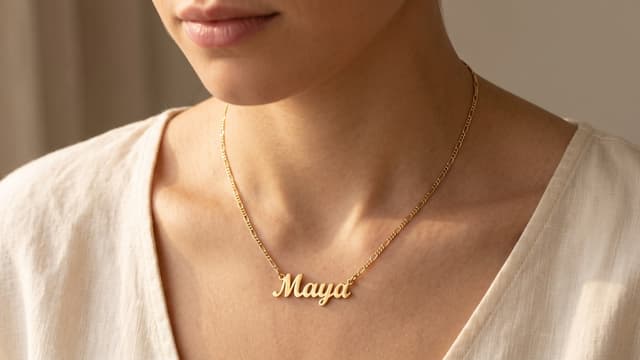
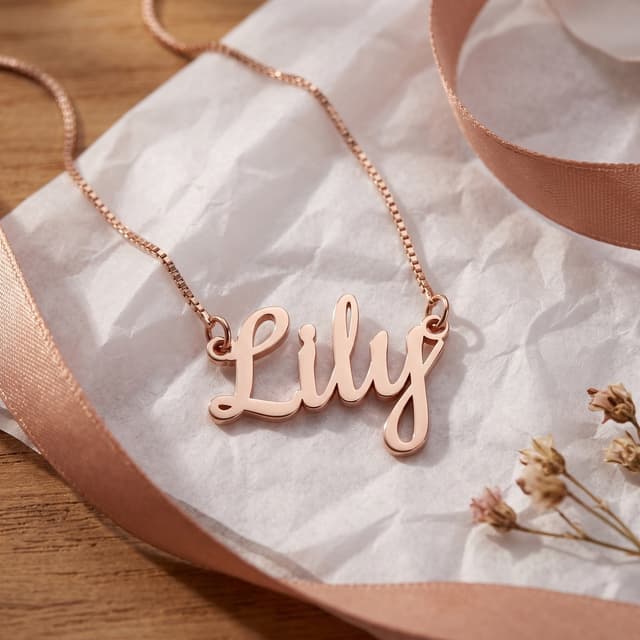
Here is the structural advantage you have and mass-import sellers don’t: a personalized piece has no direct price comparison. A shopper can compare ten generic heart pendants on price alone. She cannot comparison-shop a necklace with her mother’s handwriting-style name in gold vermeil for her mother’s 60th. She can only decide whether this one is right. Made-to-order engraving turns your listing from a commodity into a small commission, and commissions are priced by what the moment is worth, not by grams of silver.
Which is also why competing on price against mass imports is unwinnable and not worth attempting. Someone will always sell a machine-stamped bar necklace for $12. Let them. You compete on specificity: the occasion (new mom, quinceañera, retirement), the recipient (grandmother of twins, best friend moving away), the niche your shop owns. The narrower the story, the less the price matters, and the more of that 3–4x multiple you actually keep.
Free-shipping economics
Bake shipping into the price. Almost always. Three reasons. First, buyers convert better on a single clean number than on a $67-plus-$7.95 surprise at checkout. Cart abandonment loves a shipping line-item. Second, on Etsy the transaction fee applies to shipping anyway (as of mid-2026), so charging it separately doesn’t dodge the fee; it just makes your listing price look smaller while your customer pays the same total. Third, Etsy has historically favored free-shipping listings in US search placement, and “free shipping” is a filter shoppers actually click.
The one exception: expedited upgrades. If a buyer wants it faster than the standard ~12-business-day production-and-delivery window, charging a real rush fee is fair, expected, and protects you from absorbing express costs on a piece that was priced for standard delivery.
Tier the line: entry, core, statement
Don’t price 40 listings at 40 similar prices. Structure them, because the tiers do different jobs:
- Entry pieces: the trial purchaseYour simplest designs at your lowest (still 3x-ish) price. Their job is to convert a first-time buyer who’s never heard of your shop. You earn less here; you’re buying a review and a repeat customer.
- Core pieces: the volumeYour name necklaces and bestselling engraved pieces at your standard multiple. This is where the worked example lives and where most of your profit should come from.
- Statement pieces: the perception anchorA few premium listings (sterling silver versions, elaborate designs) priced high. They may rarely sell, and that’s fine: they make your core pieces look reasonably priced and signal that you’re a real jeweler, not a discount bin.
The quarterly reprice
Pricing is not a launch decision; it’s a quarterly routine. Put 30 minutes on the calendar every three months and read your stats with one question in mind: is the market telling me I’m underpriced? The tell is a listing with strong views and an unusually high conversion rate, meaning shoppers see the price and buy without hesitating. That hesitation you’re not seeing? It was margin you didn’t take. Raise the price 10–15%, watch for four weeks, and repeat until conversion settles back to normal for the category. Do the reverse check too: strong views with near-zero conversion usually means a price/photo/trust mismatch, though fix the photos before you touch the price.
The discount trap
One worked number, because this is where good margins go to die. Take the $75 Etsy necklace earning $40.17. Run a “20% off” sale: the price drops to $60, and after the (slightly smaller) fee stack you clear about $27. You gave up 20% of the price and a third of your profit, and you’d need to sell roughly 50% more units just to make the same money. On an Offsite Ads order the damage is worse still. Reflexive sales don’t create demand for personalized gifts anyway. Nobody buys a graduation necklace because it’s Tuesday and there’s a coupon. They buy because there’s a graduation.
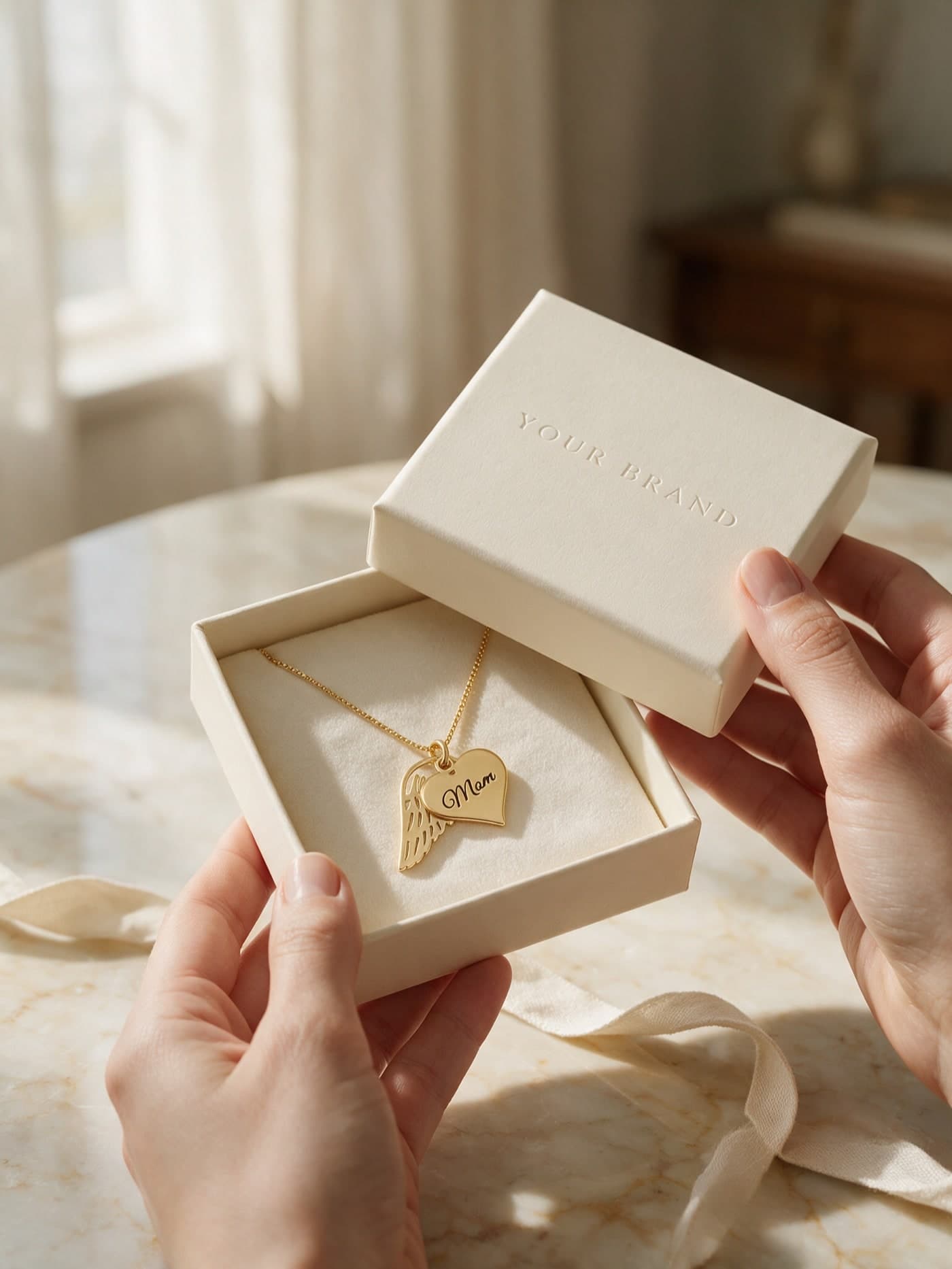
- Add value instead of cutting price: free gift wrap, a complimentary chain upgrade, a bundled second charm.
- Reserve genuine discounts for genuine strategy: clearing a retiring design, or a one-time offer to past customers on your own store.
- Recalculate your full stack before any promotion and check what per-order profit survives it.
- Run “always-on” sales. Permanent 20%-off teaches buyers your real price is the sale price.
- Match a mass-import seller’s price. You’re not selling the same product, so stop pricing like you are.
- Discount your entry tier; it’s already doing the job a discount would do.
FAQ
Do Etsy fees really apply to my personalization charge?
Yes. As of mid-2026, Etsy’s 6.5% transaction fee applies to the item price plus shipping, gift wrap, and personalization charges. That’s why we recommend folding personalization into the base price: one clean number for the buyer, and no illusion that a separate charge escapes the fee.
Should I price differently on Etsy vs my own store?
You can, modestly. Many sellers keep prices identical for simplicity; others price their own store slightly lower (or add perks there) to reward direct buyers, since there’s no marketplace cut. Just model both stacks first. As the worked example shows, the profits land closer together than the fee schedules suggest, because your own store carries the marketing cost.
Is 3–4x your cost a rule I have to follow?
No. It’s common guidance, a starting point that reliably survives the fee stack. Your niche, photography, and reviews may support more. The rule that is close to a law: know your full per-order cost stack before you set any price, and don’t go where the stack says you can’t.
What should my refund-and-remake reserve actually be?
Start at 2–3% of revenue and adjust to your own history after a quarter. Clear personalization previews and a firm “double-check the spelling” step in your listing photos will push it toward the low end.
Will the fee numbers in this guide stay accurate?
Treat every figure here as “as of mid-2026.” Platforms revise fees, and Etsy has changed its transaction fee before. The method (list every cost, subtract honestly, price from what remains) doesn’t expire. Recheck the official fee pages each quarter when you do your reprice.
Does the ~12-business-day delivery affect what I can charge?
Less than you’d fear. Buyers of made-to-order jewelry expect a production window; it signals the piece is actually made for them. State the timeline clearly, and for gift-deadline seasons, market early (“order by” dates) rather than discounting late.
Your price for every design is right on its page in the catalog. Before you set your next price, pick your top three listings and run this exact stack on each (your cost, fees, ads, reserve) and see what each order really pays you. Ten minutes of arithmetic now is worth a quarter of quiet margin later.