Key takeaways
- Etsy search is a two-stage game: keywords decide whether you qualify to appear, engagement decides how high you appear. You need both: a perfectly tagged listing nobody clicks still sinks.
- Put the buyer’s exact phrase first in the title. On mobile (where most Etsy shopping happens), only the first few words survive truncation.
- Use all 13 tags, all as multi-word buyer phrases. Never spend a tag on something an attribute already covers.
- External traffic (Pinterest, Google) does not rank you directly, but the clicks and sales it sends do, by feeding your conversion signals.
- Re-optimize by editing, never by delete-and-relist. A listing’s sales history is its most valuable SEO asset.
How ranking actually works in 2026
Forget the idea of one mysterious score. Etsy search runs in two stages, and they answer different questions. Stage one is query matching: does your listing contain the words the buyer typed? Etsy scans your title, tags, categories, and attributes. If “gold name necklace” appears nowhere in that set, you are invisible for that search. No amount of five-star reviews saves you. Stage two is listing quality: among everything that matched, who deserves the top rows? That is driven by how buyers behave around your listing (click-through rate, favorites, conversion rate, reviews), plus recency (new and renewed listings get a small temporary boost while Etsy learns how buyers react to them) and, for US sellers, shipping price.
You will see SEO tools put numbers on this: roughly 40% query matching, roughly 35% listing quality is a common breakdown. Treat those as third-party estimates, because that is exactly what they are. Etsy has never published weights; it publishes the list of factors (relevancy, engagement, recency, listing and shop quality, shipping price) and keeps the recipe to itself. The estimates are still useful as a mental model: keywords and buyer behavior each carry serious weight, and neither can carry the listing alone.
Titles that get found, and clicked
The structure that works now is simple: [primary product phrase] | [modifier] | [occasion or recipient]. The primary phrase is the buyer’s exact search language: “personalized name necklace,” not “bespoke identity pendant.” Exact phrases match more strongly than the same words scattered around the title, so keep the money phrase intact and up front. Everything after the first pipe is for long-tail matching and for the human deciding whether to tap.
Here is the difference in practice, using pieces you can source from our catalog today:
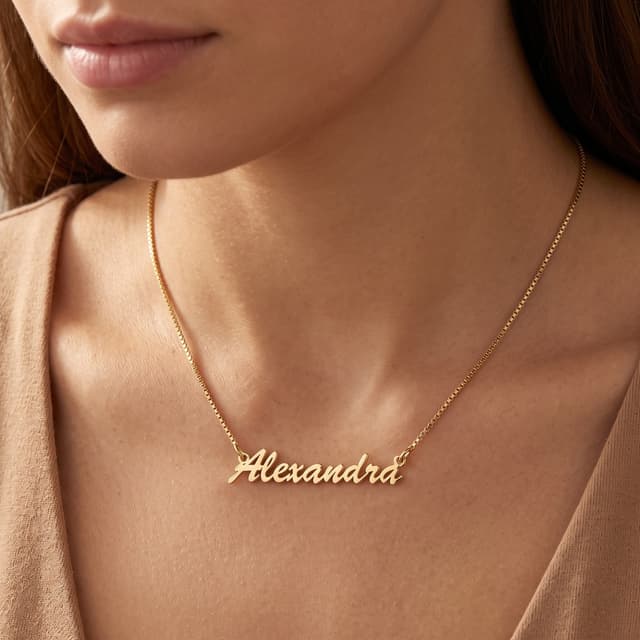
- Personalized Name Necklace | Gold Plated Custom Nameplate | Gift for Her, Mom, Bridesmaid
- Engraved Bar Necklace | Custom Coordinates or Roman Numerals | Anniversary Gift for Wife
- Initial Necklace with Birthstone | Dainty Letter Pendant | Personalized Gift for Grandma
- Beautiful Handmade Custom Jewelry Perfect Gift ❤ Necklace Name Gold (no exact phrase, keyword soup, emoji noise)
- Necklace, Necklaces, Name Necklace, Gold Necklace, Custom Necklace (repetition adds nothing; Etsy matched “necklace” the first time)
- GIFT SALE!! Personalized jewelry for her mom sister aunt best friend (the product itself is buried; on mobile the buyer sees “GIFT SALE!!” and keeps scrolling)
All 13 tags, zero waste
Tags are 13 slots of 20 characters each, and most shops waste half of them. The two classic sins: single-word tags (“necklace”, too broad to ever win) and repeating what an attribute already covers (if you selected Gold as the material, a “gold” tag is a slot burned on nothing, since attributes already act as search matches). Every tag should be a multi-word phrase a real buyer would type.
The highest-value tags describe intent, not just the object. Someone searching “bridesmaid proposal gift” is closer to checkout than someone searching “necklace,” and there is far less competition for the phrase. Spread your 13 slots across product synonyms (necklace in one tag, pendant in another, since buyers describe things differently), styles (“dainty gold necklace”), and occasions (“gift for new mom”).
- Multi-word buyer phrases: “custom name necklace”
- Occasion and recipient intent: “bridesmaid proposal”
- Synonyms across tags: pendant, charm, nameplate
- All 13 slots filled, every listing, no exceptions
- Single words: “jewelry”, “gift”, “gold”
- Anything an attribute already says (material, color)
- Plurals of existing tags: Etsy treats them as identical
- Deliberate misspellings: search auto-corrects them anyway
- Trending terms unrelated to the piece: clicks without sales drag your quality score down
Attributes and categories: the free keywords everyone skips
Attributes and categories are matched like keywords, which makes them the cheapest SEO on Etsy: structured, unambiguous, and they don’t cost you a tag. Yet shops leave them half-empty constantly.
Two rules. First, go as deep in the category tree as it lets you: not Jewelry, not even Necklaces, but Name Necklaces if the path exists. Choosing the deepest subcategory automatically includes you in every parent category above it, so there is no reach penalty, only extra precision, and eligibility for category filters. Second, fill every attribute that applies: material (gold, sterling silver, rose gold), color, occasion, recipient. For chain length (the question personalized-jewelry buyers ask most), use your variations so it appears cleanly on the listing, and mention common lengths in the description. Buyers filter by these fields; a listing with empty attributes simply is not in the results when they do.
External traffic: the quiet flywheel
Etsy does not list Pinterest pins or Google visits among its ranking factors, and third-party guides that say external traffic “boosts SEO” are skipping a step. Here is the actual mechanism: an external visitor who clicks through and buys improves your conversion rate and engagement numbers, and those are ranking factors. External traffic is a way to feed the quality score with buyers who never saw your competitors, because they arrived on your listing directly instead of through a search page with forty rivals on it.
The minimal-effort version, and the one I would actually do: pin every new listing to Pinterest the day it goes live. You already have the photo; the pin description is your title plus two tags. Ten minutes a week, and personalized jewelry is exactly what people are on Pinterest to find: gift ideas for weddings, new moms, memorials. Pins also surface in Google image results, so one action quietly covers both channels.
The 20-minute audit: re-optimize without resetting history
A listing with sales history outranks an identical fresh one, because Etsy already trusts it. So the golden rule of re-optimization: edit the listing, never delete and relist it. Editing keeps your reviews, favorites, and conversion history intact. Here is the pass I run on any listing that has decent views but weak sales: twenty minutes, one listing, once a quarter.
- Pull the numbers first (3 min)In Shop Stats, check visits, favorites, and orders for the last 90 days. Low visits = a matching problem (title, tags, attributes). Decent visits but no sales = a listing-page problem (photos, price, first line of description). Diagnose before you touch anything.
- Check which searches you already win (3 min)Shop Stats shows the search terms bringing you traffic. Terms that convert stay untouched. Protect them. Terms bringing visits but zero sales are candidates to swap out.
- Rebuild the title front-first (4 min)Is the buyer’s exact phrase in the first 40 characters? If your best-converting search term is buried at the end of the title, move it to the front.
- Sweep the tags (4 min)All 13 used? Kill single words, duplicates of attributes, and plurals of other tags. Replace each with a long-tail occasion phrase from the keyword bank below.
- Fill attributes and deepen the category (2 min)Every applicable attribute selected, deepest subcategory chosen. This is the fastest win on the whole list.
- Audit the first photo like a buyer (2 min)Shrink it to thumbnail size. Can you read the name on the necklace? Does it look different from the ten listings around it? Your thumbnail is your click-through rate.
- Make one substantial change, then wait (2 min)Save, note the date, and give it 30 days before judging. Shuffling two tags weekly tells you nothing; a real title-plus-tags revision measured over a month tells you everything.
A keyword bank for personalized jewelry
Steal from this list when you rebuild tags and titles. These are buyer-intent phrases, the language of someone shopping for a person or an occasion, which is how nearly all personalized jewelry is actually found.
- Core product: name necklace, custom name necklace, personalized necklace, initial necklace, engraved necklace, nameplate necklace, bar necklace
- For her: gift for mom, gift for grandma, new mom gift, gift for wife, girlfriend gift, gift for her
- Weddings: bridesmaid gift, bridesmaid proposal gift, maid of honor gift, bridal party gift, wedding day gift
- Milestones: bat mitzvah gift, sweet 16 gift, graduation gift for her, quinceañera gift, first anniversary gift
- Memorial: memorial jewelry, remembrance gift, sympathy gift, loss of mother gift, memorial necklace
- Style modifiers: dainty gold necklace, minimalist jewelry, layering necklace, birthstone jewelry, old english name necklace
FAQ
Will editing a listing hurt its ranking?
No. Editing keeps your history, reviews, and favorites attached. What resets a listing is deleting it and relisting from scratch, which throws away everything Etsy has learned about it. Edit boldly; relist never.
Should I renew listings constantly for the recency boost?
The renewal boost is real but small and temporary. Etsy uses it to gather fresh data, not to reward the renew button. As a standing strategy it is a fee generator, not an SEO one. Renew when you have actually improved something.
Do keywords in the description matter?
Etsy has said search considers descriptions, so put your primary phrase naturally in the first sentence or two. But write the rest for the human. The description’s real SEO job is closing the sale, and conversion is the signal that moves rank.
How long until changes show results?
Give any substantial revision about 30 days before you judge it. Etsy needs enough impressions and clicks to re-score the listing, and week-to-week noise will fool you into undoing good changes.
Does our ~12-business-day delivery hurt ranking?
Made-to-order processing times are normal on Etsy; it is the handmade marketplace, after all. What hurts is surprising buyers: set your processing and shipping profile honestly, and the timeline becomes a non-issue in reviews, which is where it would otherwise bite your quality score.
Is Etsy SEO different for made-to-order personalized jewelry?
The algorithm neither knows nor cares who produces the piece. Your listings compete on the same terms as everyone else’s, which is the point: your edge is that production is our problem, so your hours can go into titles, tags, and photos instead of a soldering bench.
Put it to work
The fastest way to apply this guide is to pick three designs and build one occasion-optimized listing for each: a bridesmaid angle, a new-mom angle, a memorial angle. Browse the catalog and start with a design you can title in five honest words.